

By Todd Ferguson
What is the future of religion in our world? Religious communities are experiencing many rapid changes in our world, and often the future of faith seems unknown. Sociologist Linda Woodhead and journalist Andrew Brown used the metaphor of a river to describe the changes that faith traditions are experiencing. When a river changes from calm waters to whitewater rapids, the water itself is not changing—it is the riverbed that has changed. It is the same with religion. When a religious tradition experiences swift changes, we must look at the “riverbed,” or surrounding society, and not just the religion itself. How is the “riverbed” changing around us? What impact are societal changes having on our faith traditions? I think there are two powerful societal changes that we are experiencing that affect the future of faith: secularization and technology.
Secularization
Every Western society is experiencing secularization. With each younger generation, there are both fewer religious people and an overall lower level of trust in religious institutions. This will have profound consequences on the future of faith. Religious leaders will have to wrestle with the question of how they connect with younger generations. If they do not develop younger members of the faith, religious traditions will continue to experience major declines. Secularization also brings up the idea of real estate. Religious congregations hold a vast amount of property. As fewer people attend congregations, some congregations will close. Others will remain open but will be a small group of attendees with a large empty building. What do religious groups do with the property? How can faith traditions use this resource for the benefit of society?
Technology
Besides the demographics of secularization, the changes stemming from technology will also affect the future of faith. Artificial intelligence is one of the most powerful tools that humanity has created in the past century. We have not yet fully grasped its implications on religion. From describing AI as having “god-like” properties, to trying to embed morality within AI systems, to my own work on the religious bias embedded within large language models, AI interacts with faith on multiple levels. It is such a pressing issue that Pope Leo XIV recently published his encyclical Magnifica Humanitas about human personhood when confronted with the emergence of artificial intelligence. Religious communities will wrestle with the implications of AI as we see this technology progress. We are only at the cusp of this seismic change.
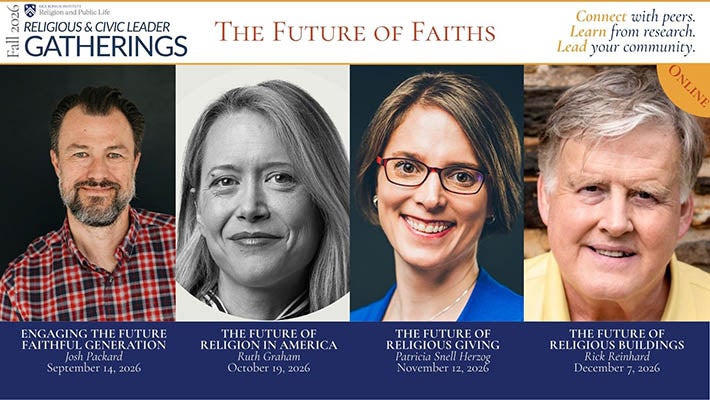
The Future of Faiths at the Religion and Public Life Center
Both of these two large social forces—secularization and the rise of AI—are affecting the future of faith. The Religion and Public Life Center will host a series of Religious and Civic Leader Gatherings for the 2026-2027 season centered on this theme of “Future of Faiths.” We are going to kick off the season with an evening with Josh Packard, author of Faithful Futures: Sacred Tools for Engaging Younger Generations, where we will hear about how to connect with young adults in the midst of increasing secularization. The season will also include an evening with Ruth Graham, the religion correspondent for the New York Times and a virtual conversation with Greg Cootsona, executive director of AI and Faith. Our goal is to convene meaningful conversations with some of the best thinkers to help religious and civic leaders think through the changing “riverbed” of technology and secularization. We hope you can join us.