
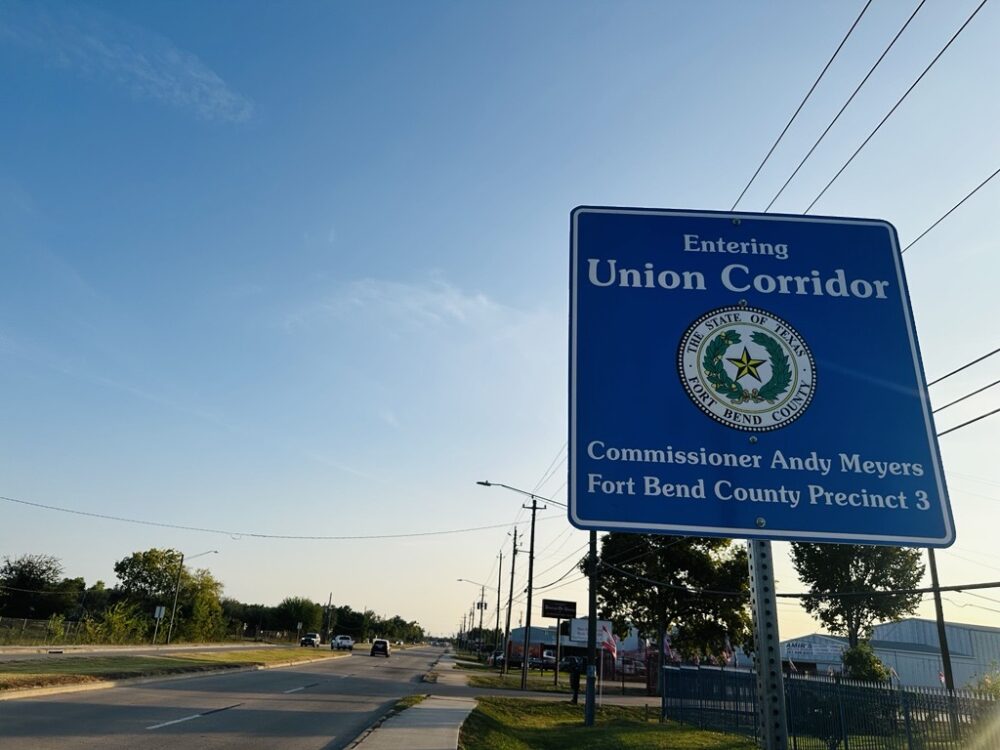
Houston is an exciting place to study religion. This city is dynamic in almost every way: economically, linguistically, culturally, and especially religiously. Recently, a street that connects Houston to the suburbs in Forth Bend County (Synott Road) was named "Union Corridor" because it had eight different religious houses of worship along a short span of road, including a Hindu temple, an Islamic masjid, a Buddhist temple, and multiple churches.1 Union Corridor is a microcosm of the larger city. Houston is growing, not only in terms of its population, but also in terms of the presence of religious communities.
I decided to take a deeper dive to report about the expanding landscape of religion in the Houston community. To discover this, I turned to the US Religion Census accessed through the Association of Religious Data Archives (ARDA).2 This is our best estimate of how many congregations and religious adherents are in each county.
Harris County Has An Increasing Percentage of Religious People
Source: US Religion Census, Association of Religion Data Archives (www.thearda.com)
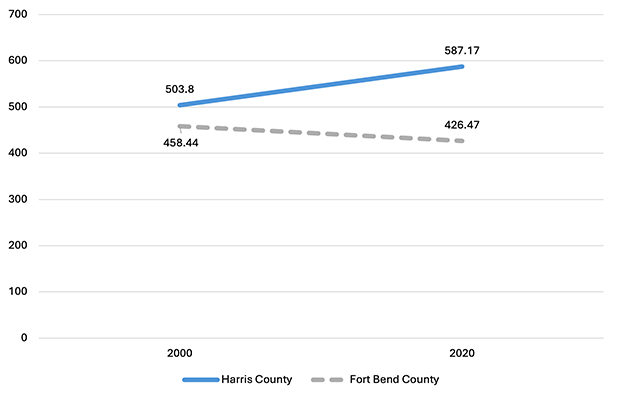
The "adherence rate" is increasing for Harris County (where Houston is located) and Fort Bend County (containing large suburbs, like Sugar Land and Katy). As shown in Figure 1, 504 out of every 1,000 Harris County residents were members of a religious group in 2000. This increased to 587 for the year 2020. This means that over 58% of all Harris County residents were affiliated with a religion in 2020. So, while Harris County is growing in population, it is also growing in the percentage of its residents who are religious. The same cannot be said for Fort Bend County, however. It's religious adherence rate has decreased since 2000, going from 458 per 1,000 residents to 426.
Religious Change in Harris and Fort Bend Counties
So, if Harris County has a higher percentage of its population who are religious, which groups are actually growing? Which religious traditions are increasing their number of congregations, and which traditions are growing their number of individual adherents? Figure 2 shows the change from 2010-2020.
Growth: It's Not Necessarily About Immigration

Source: US Religion Census, Association of Religion Data Archives (www.thearda.com)
The blue bars of Figure 2 represent the change in congregations. One might think that this is a story of immigration - traditions associated with immigrants would have the greatest growth in the number of congregations. This is not the case. Buddhists, for example, have lost congregations since 2010, along with Mainline Protestants (think United Methodists, Episcopal Church, and Presbyterian Church (USA)), and Other Religious Groups (like Sikh, Baha'I, or the Unification Church).
But other traditions are adding more congregations, and they are not necessarily those with a traditionally large number of immigrants. Black Protestants have grown the most over the last decade, with a 67% increase in the number of congregations since 2010. Other traditions have experienced around a 30% growth in congregations, including Christian Orthodox (39%), Islam (37%), Judaism (30%), and Latter-Day Saints (27%).
Black Protestants and Hindus Have Increased Their Adherents
When we look at which religious traditions have grown in the number of adherents, a different story emerges. Black Protestants have experienced the greatest growth over the past 20 years, with a 103% change over time (that's more than double). Followed closely behind are Hindus. Event though they did not experience a high rate of growth in the number of temples, they changed 99% (almost doubling) the number of adherents. The Christian Orthodox (58%), Catholic Christians (27%), Evangelical Protestants (17%), and Latter-Day Saints (21%) also grew in numbers over this time period.
Yet, some religious groups actually shrank. Mainline Protestants lost 19% of their members, while Jews and Other Religious Groups lost 8% and 11% of their ranks, respectively. Buddhists have remained relatively steady, only losing 1% of their adherents. For Islam, we do not have accurate estimates of their individual population. While it is relatively easy to count mosques, it is much more difficult to count individuals. if I were to guess, I would say this group is also growing as well.
Houston: The City of Dynamic Faith
What do these numbers tell us? First, Houston is religiously dynamic. In a Western society that is experiencing an increase in the "Nones" and a decrease in the number of religious people, Harris County is actually growing its religious ranks. Congregations are opening and a higher percentage of people affiliate with a faith tradition. This is why a street nicknamed Union Corridor is not surprising. In a religiously dynamic city, we would expect a Catholic church to be next to a Buddhist temple in our area. We live and work and worship next to neighbors from other faith traditions.
Second, there is a sense of entrepreneurship and engagement in our religious communities. While some groups are losing both congregations and members, like Mainline Protestant Christians, many faith traditions are opening up additional congregations and growing their memberships. For example, the Ismaili Center recently had its grand opening in Houston this year, a center dedicated to interreligious dialogue and one of the few Ismaili Muslim communities in the United States.3
Third, Houston is the ideal place to think about how religion intersects with our public life because religion is a part of our public life. Religious traditions shape our city, like with Union Corridor. Our congregations are at the forefront of providing social services in our neighborhoods. When the RPLC hosts its monthly Religious and Civic Leader Gatherings, we bring together leaders from this dynamic and religiously vibrant city to have conversations about how religion affects our community, and the context of Houston for the work that we do together makes all the difference. Houston is an energetic, entrepreneurial, growing, and dynamic city where the world's different religions can live peacefully together to work toward the common good.
1 https://www.houstonpublicmedia.org/articles/news/religion/2025/11/10/534658/houston-religion-diversity-places-of-worship-fort-bend/
2 https://www.thearda.com/
3 https://the.ismaili/us/en/spaces/ismaili-center-houston