
By Aishwarya Lakshmi
As we reflect on our times and the role religion plays in shaping events of historical significance, the Boniuk Institute draws on internal expertise to offer a historical perspective.
As is well-known, the Revolt of 1857 in India (in the then conglomerate of principalities comprising of Hindustan, ruled by the Mughal Emperor, and other smaller southern kingdoms), was marked by violence on both sides. The Revolt was initiated by a group of Indian sipahis/sepoys (soldiers) in the Bengal Army (an arm of the British East India Company army). The ostensible reason for the revolt was the grievance produced among the soldiers at having to use the Enfield rifle, a new kind of rifle introduced in the army, which required the soldiers to bite off the greased cartridges before use. These cartridges were rumored to be coated with cow and pig fat, and thus offended the religious sensibilities of Hindu and Muslim soldiers alike. On 10 May, 1957, a group of soldiers in Mirath, a town in northern India, revolted and killed their commanding officers. The soldiers then marched to Delhi and crowned the by now merely titular Mughal Emperor, Bahadur Shah Zafar, as king of the realm. The revolt was taken up by other regiments and heads of Indian principalities across much of the north, and a prolonged struggle followed between this group and the British, marked by violence on both sides, until the eventual victory of the British in November 1858.
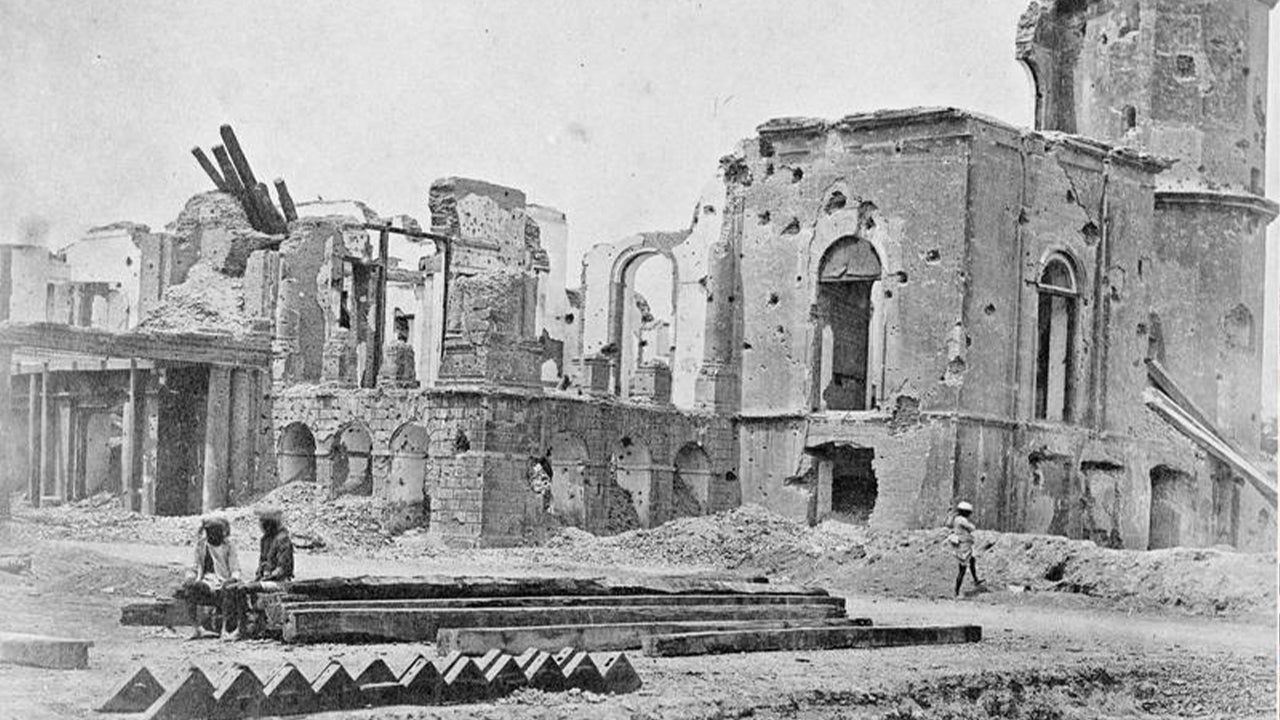
The author’s research reveals that the violence of the 1857-1858 years changed the sense of the land, including imaginaries of home, motherland, and territory/empire, on the part of Indians and British alike. What were at play were primarily sacred imaginations of home and (Mughal) empire, as evidenced in paintings and writings of the time. Thus, an Indian sepoy, Sitaram, describes his travels as a soldier in Bengal army as one that takes place in a land that maps on to the home and exile spaces of the Ramayana, a sacred nexus of land and time within Hindu mythology, and which the mutiny destroys. Similarly, Ghalib, the famous poet writing in Persian, imagines the Mughal empire with its nexus of forts and gardens as an Islamic “paradisiacal garden” that is no longer possible after the mutiny. On the part of the British, the imaginary changed too, from an earlier picturesque representation of India, where difference is validated for its visual appeal, to a more heavily symbolic representation, played out on the moral registers of good and evil.
For us, in these times, it is good to remember that religious pluralism has been a state (or monarchic) sanctioned ideal across ages and bolstered by practices and imaginaries in lived life. Furthermore, “religious violence” rarely has religion alone as its source; it is often paired with other grievances, socio-economic and/or directed towards the state. And finally, a violent historical event always has repercussions, not only at the individual level, but in imaginaries of home, homeland, and nation or empire, for the people of the nation experiencing the violence and the aggressor. The very imaginaries that are lost or shattered, however, can be the source of rebuilding anew.