
By Todd Ferguson
In our recent conversations at the Religion and Public Life Center, I have noticed a common thread. There is a convergence of two large social patterns affecting religion in North America: social sorting and Christian Nationalism. Sorting is the idea that we are increasingly living in homogenous groups.
This idea, going back to Bill Bishop’s book “The Big Sort” from 2008, means that we do not meet with, mingle among, or talk with people who are different from us. We live in uniform spaces, whether that uniformity is political, economic, or even theological. The second large pattern is Christian Nationalism. This is a cultural identity that fuses the idea that to be American is to be Christian (and vice versa). From this perspective, America is a Christian nation, and there is very little room for citizens of other faiths.
These two powerful social forces are shaping our religious landscape where what remains are more homogenous congregations, many of these filled with Christian Nationalists. As Ryan Burge has empirically demonstrated, conservatives are more likely to worship alongside other conservatives, while liberals share a pew with other liberals (an increasingly rarer occurrence). Because of Christian nationalism, both Liberals and Conservatives who are not Christian Nationalists feel pushed out of many religious spaces. Ryan Burge even labeled this pattern “the vanishing church” and lamented on the loss of religious congregations that are “moderate” – congregations where Republicans and Democrats, working class and upper class, zealous believers and those with some doubts – can interact with one another.
As we at the RPLC have spoken with scholars like Ryan Burge, John Inazu, and Justin Meyers, I have come to more fully understand the profound need for spaces where people of all religious traditions, socioeconomic backgrounds, and political leanings can interact with each other. It makes me wonder where I can have meaningful conversations with others who are different from me. Where are the institutions that create spaces for Americans to live out the ideal of “E Pluribus Unum?”
Because I am a sociologist, I am always thinking about large social patterns like these, and my mind turned to these ideas a few weeks ago while I took my son camping with the Cub Scouts. I was pleasantly surprised because what I encountered gave me a vision of an alternative possibility.
This past year, I volunteered to lead my son’s kindergarten Cub Scout den. It has been a fun year working with these energetic 5- and 6-year-olds while we explore the outdoors. One of our main activities is camping. I am not a natural outdoorsman, but thankfully, the Houston-area Scouts has a ranch where we newbies can learn how to camp. For this campout, my son and I set up our tent on Friday evening with our neighborhood group (what the Cub Scouts call a “Pack”) and went to sleep. Yet, when we went to breakfast the next morning with the other Houston-area Packs, I witnessed an alternative possibility to the Big Sort and Christian Nationalism.
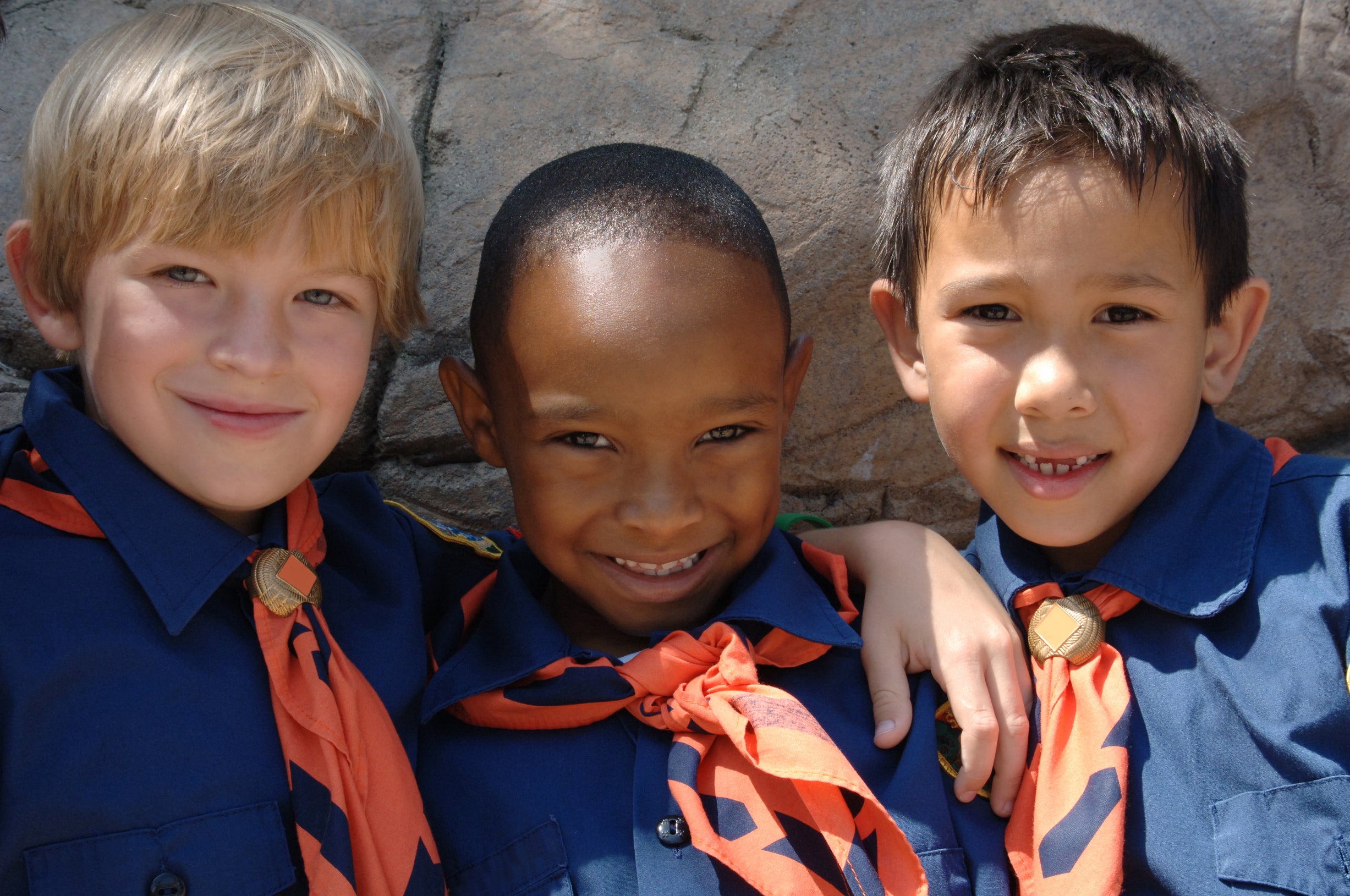
The Scout ranch cafeteria was filled with Cub Scout Packs from all around the Houston area. (Yes, there was a cafeteria because this was a campout for people like me–the inexperienced outdoorsman.) I looked across the tables, and I witnessed a palpable sense of diversity. I saw Packs that were majority Indian-American and Hindu. Others were largely Arab-American and Muslim. There were Packs from rural Texas sponsored by their local Catholic parish and were mainly White. After breakfast, we gathered for the flag ceremony. There was a color guard, and we pledged allegiance to the American flag. After breakfast and the opening ceremony, we went to our Scouting activities and were able to interact with the other Packs.
The racial and religious diversity in and of itself was not surprising. After all, Houston is one of the most diverse cities in the United States. The patriotic elements of the flag ceremony were not surprising either. Scouting has always promoted patriotism. What stuck out to me, however, was the combination of the two that provided an alternative vision of a pluralistic America that runs counter to both the “Big Sort” and Christian Nationalism.
This event was able to honor and respect the different faith traditions represented by the Packs. “Reverence” is a key expectation of Scouting–it’s one of the elements of the Scout Law that is recited each meeting. There is the expectation that each Scout is a faithful member of his or her religious tradition, and so the Scouts and their families were able to come to this campout as Muslims, as Hindus, and as Christians. They did not have to hide these identities. The cafeteria even offered both halal and vegetarian meal options to Scouts. Within this religiously pluralistic environment, we also honored America in a way that ran counter to the narrative of Christian Nationalism. There was a focus on service to one’s country and not a focus on who is “truly” an American. The campout also created space where we could interact with others who were different from us–politically, religiously, racially, and economically.
As a sociologist, I thought of all of these aspects throughout the entire weekend. Here was an institution that allowed families to uphold their religious traditions, honor their country, and get to know people who were different from them. It truly was an alternative vision to the social forces from the "Big Sort" that are isolating us and from Christian Nationalism that are ranking us. Instead, it was a vision of a group that was comfortable with its diversity, reverent with each faith tradition, and focused on serving the nation.
Post Script: Of course, just as Ryan Burge describes as the “vanishing church,” where moderate congregations are in decline, I would be remiss to mention that Scouting America, too, has witnessed a decline in membership, especially after the major sexual abuse scandals of the past years.