
By Kate Eubanks
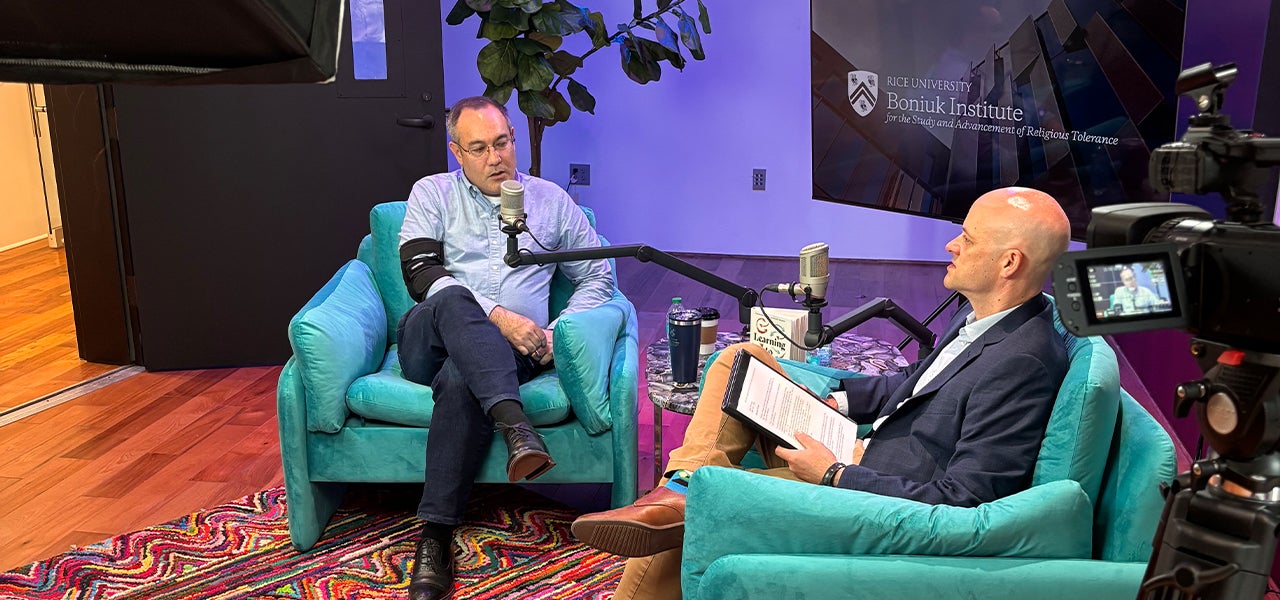
During his recent visit to Houston to receive the 2026 Boniuk Institute Senior Scholar Award, legal scholar John Inazu sat down with RPLC director and Religion Unmuted host Todd Ferguson for a conversation which reflects on the intellectual and lived foundations of his work on disagreement, pluralism, and civic life.
This latest episode centers on a deceptively simple claim: that deep differences are not problems to erase, but realities to name and understand. “We have deep and deeply formed differences that matter tremendously,” Inazu explains. “But once we name those differences… we are freed to partner generously and charitably, even take some risks toward common ground efforts.”
That tension—between difference and cooperation—runs throughout the conversation. Inazu traces his scholarly path from First Amendment law to questions of assembly, belonging, and the conditions under which people form communities. His work suggests that the right to assemble is not just legal architecture, but a window into how humans live together in groups marked by friction, loyalty, and disagreement.
Rather than treating disagreement as something to be solved, Inazu emphasizes it as a practice to be learned and practiced over time. His widely discussed book Learning to Disagree frames civic life not as a set of challenges with clear solutions, but as an ongoing discipline of patience, trust-building, and humility. In the interview, he extends this idea into everyday relationships, institutions, and classrooms—spaces where long-term formation matters more than short-term resolution.
Ferguson and Inazu also explore how religious and nonreligious diversity complicates traditional assumptions about pluralism, especially in public life. The conversation repeatedly returns to a shared concern: how communities can maintain integrity in their deepest convictions while still engaging others in earnestness rather than caricature.
Inazu’s reflections ultimately point toward a slower, more durable vision of civic engagement—one grounded not in consensus, but in the patient work of learning how to live together amid real and enduring differences.
Watch/ Listen to the full conversation on YouTube>>>
Explore other conversations from the Religion Unmuted podcast>>>