
By Todd Ferguson
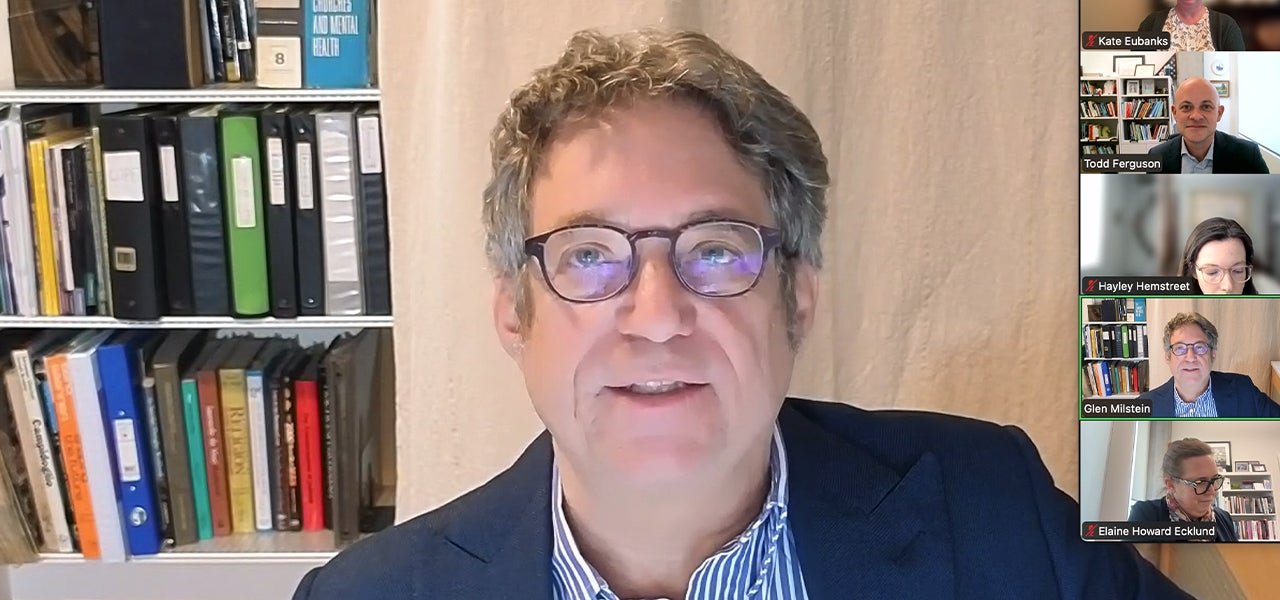
What do religious leaders do when there is a mental health crisis in their communities? Recently, the Religion and Public Life Center hosted clinical psychologist Glen Milstein in an online conversation to help leaders think through this very question. Milstein is one of the leading scholars about how mental health clinicians can partner with religious communities, and he had a surprising (and rather refreshing) viewpoint about how religious leaders can help. He asked us to think about the religious congregation as a public health center.
When someone has a mental health crisis, the primary goal is well-being, and a successful outcome is having the person reconnect back with their community as a fully productive member of society. For this to happen, people struggling with mental health concerns need a dense community that welcomes them back, especially after outpatient or inpatient treatment.
Here, this is where Milstein says congregations come in as centers of public health. Synagogues, churches, temples, and masjids are ideally suited to reintegrate people back into a dense community. Milstein told our religious and civic leaders to do what they already do because that is what is helping people reintegrate. Congregations, specifically, are highly successful at carrying out three crucial functions which help people recover from a mental health crisis.
Congregations Celebrate. Through their weekly worship services and their life cycle events like weddings and birth rituals, religious congregations help people connect to something greater than themselves and allow them to look beyond.
Congregations Respond to Suffering. Congregations give people a deeper understanding of why bad things happen in our lives. They are also often on the forefront of responses to suffering, whether that is helping after a major disaster or comforting a grieving person who has just experienced a loss.
Congregations Connect Communities. Religious congregations are one of the few "third spaces" left in cities that are neither home nor work. In an epidemic of loneliness, congregations are places where people can be with others without cost of family relation. As people get treatment for a mental health crisis, being integrated into a community is vitally important for a sustained recovery.
Milstein told us that these three functions are crucial and necessary to help people recover from a mental health crisis. He says that religious leaders should let clinical treatment and counseling fall to trained mental health professionals. Clergy do not have to fill this role. Instead, clergy need to be who they are--experts in helping people celebrate through worship, respond to suffering, and connect with others in community.
The idea of religious congregations as centers of public health goes against the common message that clergy often hear about themselves: You need more training! There is a model of deficiency in our society that tries to pressure clergy to "be more." IN addition to being an expert in scriptural interpretation, a charismatic public speaker, a volunteer management guru, and a knowledgeable steward of a theological tradition, clergy also feel the pressure to be mental health clinicians. This often looks like feeling the need to get a master's in counseling, in addition to their theological education.
Yet Milstein's model is one of strength and not deficiency. Religious leaders' and their congregations' core tasks are public health aids. Congregations are already doing exactly what they should be doing to help people reintegrate back into society and find well-being. Leaders don't have to be licensed therapists. Instead, they need to be who they are trained to be--people who lead communities through worship and celebration, responding to suffering, and connecting people with each other. By functioning in this way, congregations are centers of public health and helping those who are getting treatment for mental illness reintegrate back into society.
On March 9th, the RPLC's Religious and Civic Leader Gathering will host political scientist and statistician Ryan Burge in an online discussion on the changing landscape of religion in America. We hope that you will join us!
Revisit our conversation with guest Glen Milstein on YouTube.
Email us at BoniukInstitute@rice.edu to receive your invitation!