
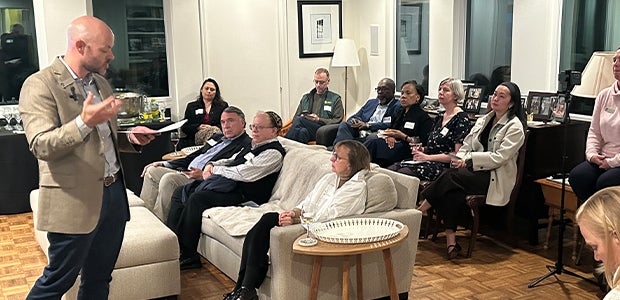
The Theme for the RPLC's Religious and Civic Leader Gathering this year is "Leading Communities in the Midst of Change." One of the most important changes that leaders are navigating is how immigration is being enforced, and the major ways that policy changes are impacting our religious communities.
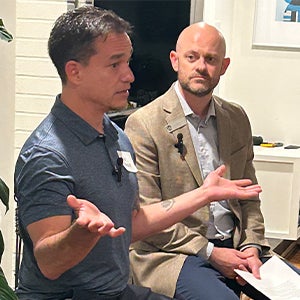
In December, the RPLC was fortunate to host Josue Treviño, a pastor at Ecclesia Church Houston, to talk about his direct experiences leading a community impacted by immigration. Treviño leads an unusual congregation, in that it doesn't host weekly worship services, but instead functions as a cultural center that houses Bible studies, a HeadStart Preschool, ESL classes, and legal aid services. Religious and civic leaders in attendance were profoundly moved by his account of how mounting fear and mistrust are stifling engagement within his congregation. He spoke in depth about his approach to his work as a religious leader--one that involves the practice of hospitality, the "ministry of presence" and showing up, and a great deal of listening to the local needs.
Pastor Treviño's experiences resonate with what scholars know about religious communities and immigration. As religious leaders have known for years and recent scholarship has shown, congregations are centers of support for immigrants in three important ways: culture, identity, and services. First, congregations help newly arrived residents maintain their culture and rituals from their home countries, but they also help serve as a bridge to acclimate to the new American culture. Second, religious congregations serve as centers of identity, where they find a community to help them navigate their new hyphenated identity of being Indian/Mexican/Filipino/etc-American. Third, congregations offer real, tangible services to immigrants, like English as a Second Language and citizenship classes.
So, while congregations are often at the center of immigrants' lives, US churches, mosques, and temples are having to discern how to serve those in their care as US Immigration and Customs Enforcement escalates deportations. Local and national religious groups are responding with information and resources.
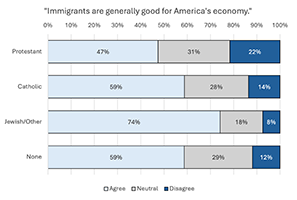
Yet, the idea that religious congregations and national religious groups are centers of support for immigrants does not tell the whole story. Religious individuals are often the most anti-immigrant groups in the United States. In the 2024 General Social Survey, Protestants are the most likely to disagree that immigrants are good for America's economy. As Figure 1 shows, one in 5 (22%) Protestants have a negative view on how immigrants affect the economy. This is 8 percentage points higher than the next groups--Catholics--who are also higher than average. Jews and individuals from other religious groups are the least likely to view immigrants as bad, at 8 percent.
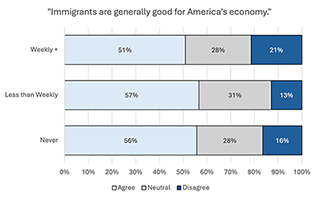
The same pattern shows for those who attend religious services more often (regardless of tradition). Figure 2 visualizes that one-fifth (21%) of people who attend services monthly or more view immigrants as bad for the economy, the highest group. So, while organizations--like local congregations and national denominations--are supporting and creating resources for immigrants, religious individuals are often those who hold the most negative views about immigrants.
These dynamics reveal that religion is a complex force in our world, but there is benefit in listening to the voices of leaders who experience large social issues firsthand within religious communities. If you are a religious or civic leader and would like to be part of these regular conversations between scholarship and lived experience in our own communities, the RPLC's Religious and Civic Leader Gatherings will meet again in January to hear from Drs. Rae Jean Proeschold-Bell and David Eagle of Duke University as they share the most up-to-date research on clergy health and wellbeing. We hope you will join us!
Revisit our conversation with guest Josue Treviño on YouTube.
If you are a religious or civic leader and would like more information about attending our invitation-only Religious and Civic Leader Gatherings, please email us at BoniukInstitute@rice.edu.