
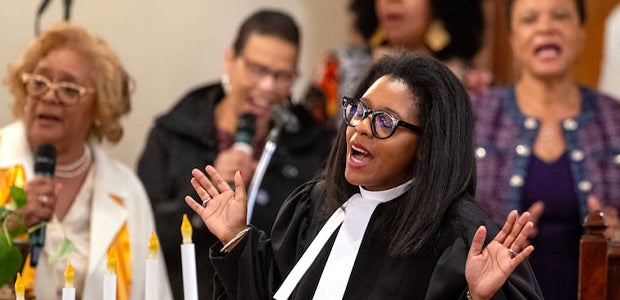

In September, the RPLC hosted Dr. Jason Shelton from UT Arlington to talk about his new book The Contemporary Black Church: The New Dynamics of African American Religion at the Religious and Civic Leader Gathering. We had an amazing conversation hosted at the beautiful University Museum of Texas Southern University, a historically Black university.
One of the major points from our discussion was that the traditional Black Church denominations (such as Baptists, African Methodist Episcopal, and Church of God in Christ) are experiencing a period of "disestablishment," particularly for its younger generations. While church membership has remained stronger in the Black Church than it has for other religious traditions in the United States, Dr. Shelton noted that even this group is losing members. For many younger people in the Black community, church membership is now "optional" and no longer "institutional." This is a major change because historically, to be a part of the Black community meant being a part of the Black Church. (Watch the conversation with Jason Shelton.)
The disestablishment that the Black Church is experiencing follows the patterns from other religious traditions in the United States. Most religious groups are losing members. How can we make sense of this?
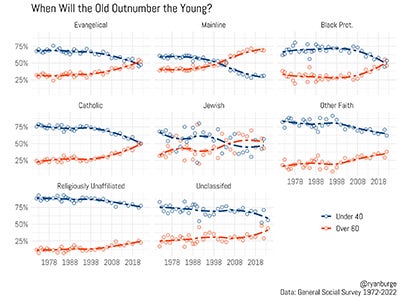
One way is to look at demographics. Dr. Ryan Burge, the leading public social scientist on religion and data (and an upcoming guest speaker at the RPLC's Religious and Civic Leader Gathering), recently posted a fascinating graph on his LinkedIn profile. He mapped out the percentage of each US religious tradition that is under 40 and above 60, which is shown here in Figure 1.
The results are stunning and tell a powerful story. Most religious traditions now have more members who are older than 60 and younger than 40. For Mainline Protestants (think Episcopal, United Methodist, Presbyterian Church (U.S.A.)), this occurred around the year 2000. For Jews, it occurred around 2006. For Black Protestants (along with Catholics and Evangelical Protestants), it is happening now. The only group where this is not occurring is in the "Other Faith" category, which is a combination of Muslims, Hindus, Buddhists, and other minority traditions.
For Jewish and Christian traditions in the US, older members now outnumber the younger members. This has profound consequences. Of course, this is not to disparage older members; there is nothing inherently wrong with having a lot of older members. But it does mean that for the next 25 years, religious groups from most traditions will see a precipitous decline as its older members die and are not replaced by a younger cohort. This puts the survival of some denominations and institutions within these traditions in peril. So, what Jason Shelton found in his data about the disestablishment within the contemporary Black Church is also showing up in patterns in the demographics of most US religions.
If this piques your curiosity, the RPLC is hosting Ryan Burge for an online Religious and Civic Leader Gathering on Monday, March 9, 2026. Reach out to us at Boniuk Institute@rice.edu if you would like to be a part of this discussion.
[1] Burge, Ryan. (2025, October 2). Here's some really bad news for Christianity in the US [Post] [Imaged Attached]. LinkedIn. https://www.linkedin.com/posts/ryan-burge-66563718_heres-some-really-bad-news-for-christianity-activity-7379285634114498560-JPQA?utm_source=share&utm_medium=member_desktop&rcm=ACoAAApVwDYB5hiLmyoqr8sOet-yDp3Rb7ywx-I